Top Event Photographers in Portland
Plan Portland event photography around participant experience, Oregon Convention Center spaces, and the images each team will use after the gathering.
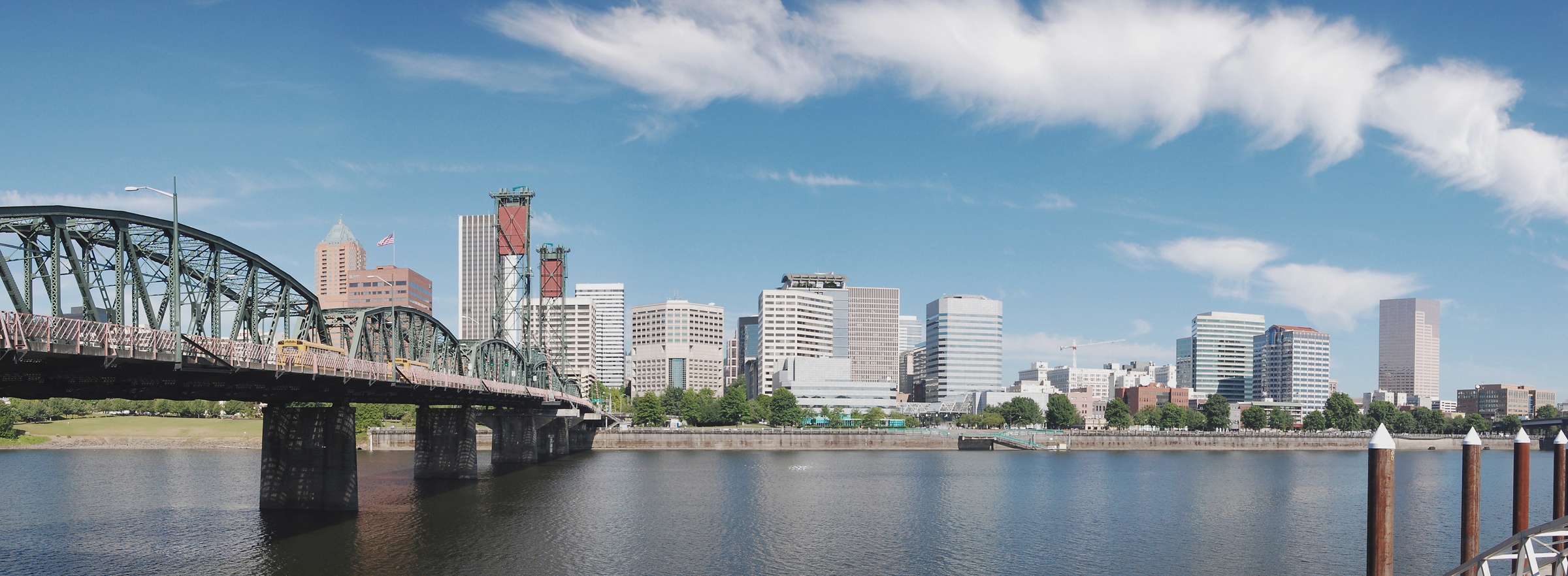
Photo: Eric Baetscher (Fcb981) / Wikimedia Commons. CC BY-SA 2.5. Archival panorama uploaded in 2007. Resized; no additional crop.

I would begin a Portland event photography brief with the participant's path. What do they arrive expecting, what do they take part in, and what should a person who did not attend understand afterward? That path gives the finished set a story without asking the photographer to interrupt every guest for proof of attendance.
The path also exposes gaps. A program can have excellent speaker pictures and still say little about how people participated. A gallery full of informal conversations can leave the main purpose unclear. The right balance comes from the commission, not a universal formula for every event.
The Oregon Convention Center's official Explore OCC page provides the local setting in this guide. All program examples are hypothetical. They are not job announcements, reports of my own work, or claims about how often Portland organizations hire. The goal is to help clients compare photographers and help applicants answer a particular event.
Plan the arrival as an introduction, not a location checklist
Ask what establishes the gathering before a formal program begins. It may be a welcoming exchange, an identifying display, or people preparing together. The client should explain which detail gives the occasion meaning rather than request every sign and corner without a purpose.
The photographer can then make setting pictures that support the story. A room by itself establishes space; a person using it can establish participation. The two can work together without repeating the same view in slightly different frames.
If the organizer needs an untouched setup documented, schedule it before guests change the scene. Confirm who says it is ready. A photographer arriving early cannot guarantee an empty, finished room if installation is still underway or another activity occupies it.
An introduction can involve people who need advance identification
The photographer may not know the welcome host, facilitator, or partner representative by sight. Give an introduction or a working contact who can identify them. A list of organization names cannot perform that task in a crowded arrival period.
If the public record must avoid certain participants, share a practical instruction and a way to follow it. Do not burden the crew with private reasons they do not need. The organizer should also identify who handles a question that cannot be settled discreetly on the spot.
Guest photography requests should not automatically override assigned priorities. A brief introduction portrait may fit; a new series of groups may displace arrival coverage. The photographer needs an authorized contact who can make that choice without turning it into an argument with guests.
Oregon and Portland ballrooms are distinct parts of a plan
The official Explore OCC page identifies the Oregon Ballroom and Portland Ballroom with their associated lobbies. A client brief should use the correct booked names and current configuration rather than simply say ballroom. Public room categories are the beginning of verification, not a complete camera plan.
For a hypothetical plenary, I would ask what must be continuously observed and what can be illustrated selectively. A keynote, recognition exchange, and audience discussion each have a different photographic rhythm. The crew should understand which moment cannot be missed.
Ask for the actual production layout and permitted positions. A ballroom's public description does not establish the installed stage, show lighting, seating, or camera movement. An applicant should state what they need to confirm rather than promise a specific view from a marketing image.
Follow the message without pretending a photograph explains every word
A speaker frame can convey expression and presence. A wider picture can place that person inside the gathering. A participant response can show that the program reached beyond the stage. The client may need all of these for different uses.
If particular subjects or presentation segments matter, identify them beforehand. The photographer should not have to decide whether a short exchange is important from its length on the timetable. A quiet moment can carry the point of the program.
If slides or displayed material are restricted, make the instruction concrete. The client may authorize event coverage without controlling every item shown. Identify the person responsible for permission and what can be included in the delivered or public selection.
Recognition needs a repeatable convention if consistency matters
If recipients should pause with a presenter, put that instruction into the program. The photographer can prepare for a consistent held image when the host and recipients know the convention. Without it, the result may be a sequence of natural exchanges rather than matched portraits.
Neither treatment is automatically better. Agree on whether the event should flow uninterrupted or allow a short photographic pause. Do not ask the crew to provide the look of a planned portrait sequence while the program deliberately prevents one.
If captions are included, get the verified order and names from the organizer. A substitute accepting for someone else must be identified. The photographer should not infer a role from a person's position on stage or from an outdated printed program.
North ABC and South DEF prompt a participation question
Explore OCC lists Meeting Rooms North (ABC) and Meeting Rooms South (DEF). Those labels help distinguish areas, but a real commission needs exact assignments and the event's current schedule. They do not support an assumed transfer time or promise of complete simultaneous coverage.
For a hypothetical workshop, ask what participation should look like in the record. Is a facilitator explaining an activity? Are people working together? Does the client need required leaders or a general sense of engagement? A photograph of occupied chairs is not the same as a clear record of learning.
If the client wants the discussion left alone, tell the photographer how to observe with minimal interruption. If an arranged group is required, give it a defined moment. The organizer should not leave the crew to discover that a candid workshop also has an unstated portrait obligation.
Choose completeness before comparing a roaming proposal
One photographer can visit several activities and deliver a useful selection. That does not mean every exchange in every room is witnessed. If the client needs uninterrupted records of concurrent programs, address staffing or revise the requirement.
A proposal should make that distinction visible. Selected participation from each room, complete speaker coverage in assigned rooms, and a continuously available portrait service are different scopes. They should not be compared as though the same general phrase describes identical work.
If room assignments change, tell the attending crew and clarify which plan is operative. A polished preparation document is not enough when the event has moved. The contact responsible for changes should know how to reach the photographer during work.
Lobbies are where the story can change direction
The official page names several lobby areas, including MLK Jr., Holladay, and ballroom lobbies. Use the actual area in the brief. A general request to photograph networking does not establish where participants gather or what the client needs to see there.
For a hypothetical interval between sessions, I would ask which relationships matter. The organizer might need a facilitator meeting participants, selected partner introductions, or a broad sense of conversation. Those choices help the photographer spend attention purposefully.
A required relationship needs people who can be identified and introduced. A logo photograph can establish a partner's presence without showing a meaningful exchange. Conversely, an interaction without clear identifying context may not serve a reporting requirement. Explain the use rather than prescribe an image with no reason.
Do not let a break become an unplanned portrait queue
An interval can look available until speakers, guests, and teams all request photographs. If formal combinations matter, create a short prioritized roster and appoint someone to gather people. The photographer cannot efficiently arrange a group while searching for unfamiliar names.
If individual portraits are part of the job, describe the intended result and any consistency requirement. A casual introduction image and a matched profile series need different preparation. Neither should be silently added to roaming coverage as an obligation without consequences.
When requests grow, have the organizer choose what to retain. Another important group can be worth photographing while still displacing another promised moment. The camera team should report that tradeoff in ordinary language before attention is reassigned.
Suite names do not settle a private program's permissions
Explore OCC identifies Holladay Suite and VIP Suites B and D. They may prompt planning ideas for a particular event, but this guide does not assume any suite is booked, accessible, or available for portraits. Obtain the actual event authorization.
A private leadership conversation also needs a clear photography boundary. Is the crew making a short arranged image, recording a presentation, or observing discussion? A general commission for the larger event does not answer that question for a restricted session.
If a person can appear only at a limited moment, schedule it and identify who brings them. An essential portrait should not depend on a casual encounter. The scope should say what cooperation is needed to make the result possible.
Separate internal records from public selections
An organizer may want a private record while limiting publication. Define the allowed audiences and factual review process. If the work includes an approval-dependent selection, make pending status unmistakable rather than let delivery imply permission to post.
The photographer's own portfolio or promotion is another use to agree on. A private gallery does not automatically authorize copying images into a public feed. Restrictions should remain clear after the event, when the immediate context is less visible.
Keep explanations proportionate. The crew needs to follow the boundary, not learn confidential background unrelated to the photograph. This is especially useful when the event has several teams with different access or publication responsibilities.
A plaza idea needs its own answer
The convention center page identifies North Plaza and Convention Center Plaza. That supports asking whether an outdoor component belongs in the actual plan. It does not establish weather, crowd conditions, permissions, or availability for an unspecified program.
If the client wants an outdoor group, confirm its purpose and authorized location. Agree on an alternative that preserves the important people and use when possible. A specific background may be optional even when the group itself is essential.
Name who decides whether to use the option and when. Waiting until participants leave can eliminate both the preferred picture and the alternative. A useful plan protects the requirement rather than simply hoping for suitable conditions.
Hire for transitions as well as peak moments
I would review a permitted complete example with a comparable participant path: arrival, main program, discussion, and informal exchange. Can the viewer understand the gathering beyond a few dramatic frames? Are routine parts usable enough for the client's needs?
Ask what the applicant personally handled. The person who made the stage pictures may have collaborated with someone responsible for portraits or delivery. Give credit accurately and compare the proposed attending crew with the roles shown in the portfolio.
If confidentiality limits what can be shared, request an authorized alternative. The new client's curiosity does not override another organization's restrictions. Respect for that boundary is relevant evidence about how your own private material may be treated.
Test preparation with one realistic change
Ask how the photographer would handle a workshop moving while the essential group becomes available. The answer should identify the conflict and the person who chooses. An honest clarification can be stronger than a sweeping assurance that both will somehow happen.
Check how current instructions will be obtained. Prior work at the convention center can help, but a past layout does not establish this program's setup or access. A first visit can be prepared responsibly when the crew knows which facts to verify.
If credentials or insurance are required, get the current specification and confirm the actual team can satisfy it. This guide does not invent a universal Portland requirement. A portfolio and a public facility page cannot prove compliance for this booking.
Make a ProShoot application specific to the participant path
ProShoot's published process includes clients posting work, reviewing bids and portfolios, and choosing a photographer. Photographers apply and present work. Use those exchanges to discuss the actual service without adding promises about demand, earnings, or guaranteed local jobs.
A relevant application explains which part of the participant experience needs uninterrupted attention, how concurrent duties will be handled, and what remains to confirm. It also checks availability from arrival and setup through the assigned work, including any agreed editing responsibility.
The proposal should identify the attending crew and the organizer's required cooperation. An application does not establish suite access, permission to use a plaza, or an invented history of Portland assignments. Relevant evidence and a credible preparation plan can stand on their own.
Compare the proposals against the same small narrative
Give finalists the same description of a participant arriving, attending a main session, joining a workshop, and meeting another guest. Ask what they would preserve at each step and where the plan has a conflict. The point is to compare understanding, not reward whoever writes the longest response.
A photographer may reasonably ask which portion is essential for the final use. That question helps the client discover its own missing decision. Another may point out that a required portrait overlaps the workshop. That is valuable before booking because staffing or timing can still change.
Keep the agreed answer with the scope. It should not remain an informal idea one department remembers while another expects a different service. A compact shared narrative makes the final gallery easier to evaluate without reducing every spontaneous moment to a checklist.
Deliver the story in a form the client can retrieve
Find out how the organization will use the result. A public recap, private participant record, and selected partner delivery may need different groupings or permissions. Agree on organization that supports those tasks instead of leaving the client to reconstruct the program from unexplained files.
If captions are included, identify who verifies names and context. If an earlier selection is requested, define its scope and explain who photographs while someone edits. Use the actual agreement for delivery, storage, and access rather than an assumed speed or retention promise.
At closeout, reconcile essential pictures with the actual event and authorized changes. Explain a canceled session, absent subject, or unresolved permission before the client discovers the gap by searching. The final result should reduce the client's work, not create a hidden audit.
I would hire for that combination of attention and clarity. Portland's rooms and program give the photographer the setting; the participant path gives the pictures a reason to belong together. A defined commission makes both the hiring decision and the finished record easier to trust.
Check the story with a person who will not attend
Ask the communications contact to imagine receiving the photographs without having seen the gathering. What would help them understand the transition from presentation to workshop to informal exchange? Their answer may reveal that the brief needs more contextual images, or that a few clearly identified people matter more than another room view.
The photographer can use that perspective without inventing a narrative. Actual names, roles, and program meaning still need a reliable client source. If the intended story depends on a particular activity, identify when it happens and whether the crew can observe it. This check also helps keep the selection proportionate. A concise participant path can be more useful than repeated frames from every interval, provided it represents the commissioned purpose honestly and does not conceal a required record that was never made.
Sources checked November 6, 2026
Ready to hire a professional photographer?
Post your job free and get bids from photographers near you.
Post a Job Free →